
Death in a Shallow Pond: A Philosopher, A Drowning Child, and Strangers in Need—Pt.1/2
My review of David Edmonds latest book (Princeton University Press, 2025)

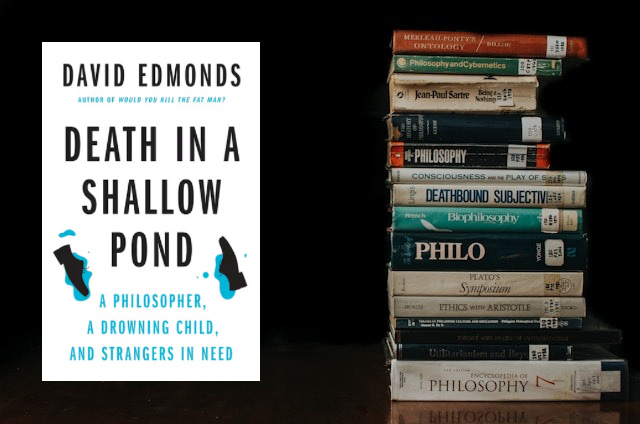
The December 8 episode of Sam Harris’s podcast, “The Philosophy of Good and Evil,” approaches David Edmonds’ latest book in a manner characteristic of its host. Harris goes straight for the most provocative thought experiments—those aggravating moral puzzles born in the seminar room—and presses them hard, with little patience for human inconsistency. Edmonds, by contrast, holds the center. Where Harris sharpens the knife, Edmonds resists condemnation, preferring to understand why moral reasoning so often falters when it confronts psychological reality. The tension between them is productive, and it was this exchange—particularly their discussion of effective altruism—that ultimately led me to the book itself.
What Death in a Shallow Pond reveals, however, is a philosophical culture quite distinct from the American technocratic imagination with which effective altruism is sometimes conflated. At roughly the same historical moment when students at Harvard were embroiled in disputes over intellectual property and emerging social networks, a small group of Oxford philosophers—among them Toby Ord and Will MacAskill—were grappling with a different problem altogether: how to persuade people to give not just generously, but consistently, and at real personal cost. Edmonds’ account makes clear that effective altruism did not arise from a start-up mentality or a faith in disruption for its own sake, but from a tradition of moral seriousness shaped by analytic rigor, postwar ethical reckoning, and a persistent discomfort with complacency.
I appreciate deeply the care with which Edmonds constructs the intellectual timeline surrounding the work of Peter Singer, the moral philosophy that shaped him, and the Shallow Pond experiment that he invented. He looks at the broad picture—the progression of ideas around morality and ethics that circulated before Singer, the traditions that underpin Oxford philosophy, the environment into which Singer emerged as a student and rising star, and of course the ideas he brought to the table.
In tracing the origin and trajectory of the Shallow Pond experiment, Edmonds does something else ambitious: he reveals the course of moral philosophy across the twentieth century, from its suspicion of ethical claims to its participation in public discourse. This was the stated goal at the outset—to examine the Shallow Pond as a major philosophical contribution, assess its real-world effects, and ask what remains today.
Edmonds is the author of several books as well as a prolific podcaster. In 2007, about the time that Ord and MacAskill were turning Singer’s idea into entrepreneurial action, Edmonds united with Nigel Warburton in co-founding the widely influential Philosophy Bites, a project dedicated to making philosophy accessible without making it thin. One thing that distinguishes Edmonds from many public intellectuals is his biographical sensibility. When he studies ideas, he studies people—where they came from, who influenced them, and what intellectual weather they moved through. With Edmonds, we get timelines and context. We get, in short, the long view.
That sensibility is grounded in Edmonds’ own formation. Trained in philosophy at Oxford, he was shaped by a culture that prizes argumentative precision, historical awareness, and a certain skepticism toward grand moral pronouncements. He later worked as a BBC journalist, a background that shows in his method: thorough, investigative, attentive to evidence, and alert to unintended consequences. This dual formation—Oxford philosophy and public-facing journalism—helps explain the tone of the book. Edmonds understands the intellectual climate in which Singer’s ideas emerged, but he also knows how those ideas sound once they leave the seminar room and enter public life. The result is a style that resists advocacy in favor of examination, and certainty in favor of clarity.
Thus, in order to answer the question as to why effective altruism might be something worth re-examining at this moment in time, Edmonds went immediately to the source—the man who had the idea in the mid-Seventies, Peter Singer, and the millennials inspired by him and it, Toby Ord and Will MacAskill. Trace its history, follow its course, find its effects today, see how it works, and pick apart the consequences. He looked at its effects across disciplines—specifically the social, psychological, and economic impacts.
What is the Shallow Pond experiment?
On the surface, it is disarmingly simple. You are asked to imagine that you are on your way to work when you notice a small child drowning in a pond. The pond is shallow. You could easily rescue the child, though doing so would mean muddying your clothes or arriving late. Variations of the scenario introduce details such as brand-new shoes or an important appointment, but the core remains unchanged: there is a child in immediate danger, and you can save that child at modest personal cost.
For most people, this does not register as a difficult moral question. The expectation that one should intervene is nearly universal. The force of the thought experiment lies in this near-consensus.
Peter Singer led the way in forming the movement of effective altruism by shifting the setting without altering the stakes: Instead of a child directly before you, the need arrives indirectly—a charitable appeal describing a child whose life could be saved through a modest donation. The question Singer poses is whether declining such a request is morally different, in principle, from walking past the drowning child. If the outcome is the same, he asks, why does the moral clarity feel weaker?
In the book, Edmonds opens with a biographical portrait of Peter Singer, outlining the formative influences that shaped him. He traces Singer’s background as the child of Jewish parents who fled war-torn Europe, found refuge in Australia, and raised him in a secular household in Melbourne. Edmonds then turns to Singer’s early intellectual development, ultimately introducing the contrast that would prove decisive: Singer’s opposition to the intuitionism of his university teacher, H.J. McCloskey.
That contrast becomes central to revealing the competence that Singer exhibited as an undergraduate student. A skilled debater, his skills of articulation were put to good use in the formation of persuasive ethical reasoning that began to take shape in these early years. He was respectful but unafraid of questioning authority when the moment called for it.
Edmonds recounts McCloskey’s thought experiment involving a sheriff in the Jim Crow American South faced with the choice of either allowing six innocent men to be lynched or saving five by fabricating evidence against one. McCloskey argued that manufacturing evidence would corrupt the justice system and therefore could not be justified. Singer took the opposing view that saving five lives was morally preferable to saving none. Edmonds uses this exchange to show that Singer was already committed to a form of utilitarian reasoning that privileged outcomes over moral intuitions and institutional purity.
As Edmonds presents it, Singer’s approach is deliberately slower and than instinctive moral response. It requires calculation, consistency, and a willingness to accept uncomfortable conclusions in the service of maximizing good.
In tracing Singer’s postgraduate years at Oxford, Edmonds situates him within a philosophical culture already under pressure. Logical positivism and linguistic analysis still structured debate, but the social and legal upheavals of the late 1960s forced moral questions back into view where philosophical academia could no longer shelter in disputes over meaning and verification. Figures such as Bertrand Russell responded by engaging openly with contemporary injustices, including the Vietnam War, and by arguing for the existence of objective moral evil.
This is the environment in which Singer’s utilitarian reasoning takes shape—not as an aberration, but as a response to a discipline under pressure to justify its moral claims without apology.
Edmonds marks this turning point with the founding of Philosophy & Public Affairs (1971), a journal that provided a formal venue for moral philosophy’s return to public life. Under John Rawls’s editorship, PPA preserved analytic rigor while engaging questions of abortion, war, and state violence. In Edmonds’ telling, its early essays demonstrate how the field moved beyond abstract moral pronouncements into carefully constructed thought experiments.
Edmonds already showed us that Singer was willing to question authority as an undergraduate student in Melbourne. The postgraduate work at Oxford only sharpened his convictions. For example, he wanted to write about Karl Marx. The faculty scoffed, discounting Marx as a real philosopher. Rather than abandon the project, Singer accepted a compromise: the paper could proceed if framed as a joint study of Marx and Hegel. The episode is presented without commentary, but its significance is clear. Singer would not retreat from his aim, nor would he challenge the institution head-on. He found a workaround that preserved the substance of his argument while satisfying formal requirements. It was an early instance of a pattern Edmonds returns to repeatedly—Singer’s emphasis on outcomes over procedural purity, and a willingness to work within constraints so long as they do not override the moral point at stake.
Edmonds also includes several moments that humanize Singer’s intellectual development. During his time at Oxford, Singer briefly aligned himself with a group of philosophers who styled themselves as radical, drawing inspiration from figures such as Heidegger and Foucault in opposition to the Oxbridge establishment. Singer quickly grew disenchanted, regarding the group’s posture as performative. The episode reinforces Edmonds’ portrait of Singer as resistant to both institutional authority and fashionable dissent.
Edmonds demonstrates Singer’s resistance to complacency through the story of his turn toward vegetarianism. Singer’s decision followed from being confronted with the realities of industrial farming. Edmonds traces Singer’s growing interest in animal welfare not for its novelty, but for what it reveals about his method and ability to make a mark: a capacity to translate moral concern into public impact. Singer’s review of Animal Liberation for The New York Review of Books helped propel what had been a relatively obscure work into a foundational text of the animal rights movement.
By the mid-1970s, Singer commanded a widening sphere of influence. Edmonds presents the humanitarian crisis in Bangladesh as a catalytic moment, planting the seeds of effective altruism, and with it Singer’s claim that if we can prevent something bad from happening without sacrificing anything of comparable moral importance, we are morally obligated to do so.
The movement gained real momentum when Tony Ord took the plunge into the pond (pun intended) and started making calculations and spreadsheets that revealed cost effectiveness. As Edmonds admits, Ord was young, nerdy, and extremely motivated to turn theory into action. Ord had the strong mathematical skills to handle the numbers, so when MacAskill came on board, he brought with him another skill set that proved invaluable—a natural instinct for public relations. With Orb handling the facts and figures, MacAskill put himself on TV to sell the idea of effective altruism to the public and produce converts.
MacAskill also tried to bring the operation out of the cramped rooms of university halls and into field work. It was through that effort that he came upon Alan Fenwick, the so-called snail man. Edmonds presents a detailed and fascinating look at Fenwick, who warrants being the subject of a book by himself, is not a philosopher; he’s a scientist obsessed with snails and the eradication of schistosomiasis in Africa. Ord and MacAskill successfully put their operations into gear to raise money for the Schistosomiasis Control Initiative, cementing a key early success story for effective altruism.
The last chapters of Part I of Death in a Shallow Pond show that the growth of Oxford’s Centre for Effective Altruism made it less of the wonky, idealist student organization that it began as—a place where employees and pledgers could toss around outrageous theories as one does in the seminar rooms—and more of the high-powered agency that inevitably invites criticism and scrutiny.
By the end of Part I, effective altruism has not been defended or dismantled; it has been made intelligible. It is in Part II where Edmonds examines the critical and practical realities of effective altruism.
What follows in the second half of Death in a Shallow Pond is less comfortable and far more contested—a reckoning that warrants a separate review. In the meantime, I’ve embedded the Sam Harris–David Edmonds discussion and Peter Singer’s 2014 TED Talk below. It’s not homework… but there might be a quiz.