

Nature and science stand in tension in Frankenstein; or, The Modern Prometheus by Mary Shelley. At the beginning of the novel, however, life is still harmonious. That harmony is what will be broken.
In Frankenstein (2025), directed by Guillermo del Toro, there is a significant shift. Victor is not romanticized, nor is his upbringing treated with nostalgia. The film condenses his background into a series of striking visualizations: the silent, gentle mother cloaked in red; the overbearing father pushing science onto Victor; the mother’s death in childbirth; and the father’s preference for the lighter, more carefree William over the brooding elder son.
But it is with the mother’s death, and Victor’s response to it, that sympathy ends. He turns away from life and toward science, becoming cold in the image of the father he resented.
This is part of the film’s composite approach to a central contrast: inherited and taught masculine obsession versus a gentler, intuitive feminine nature. The name “Victor,” imposed on both father and son (a departure from Shelley), signals the will to conquer. He is the one who would conquer nature. The world he builds stands in opposition to the natural world embodied first by the mother and later by Elizabeth.
Another composite appears in Heinrich Harlander, who blends elements of Shelley’s Henry Clerval and his merchant father. He represents industry—the financial and practical force that enables Victor’s ambition. The Harlander combination is interesting because it compresses Henry Clerval’s predilection for the Middle Ages (a more chivalrous, romantic time prior to the Scientific Revolution and the Enlightenment) and his father’s bias against liberal education. It also compresses the story into something where the tension lies chiefly between conquest and intuitive gentleness rather than straightforward good and evil.
The film, then, is a modern retelling that frames the creator much more clearly as the villain. Where the novel leaves moral judgment ambiguous, the film sharpens it: the creator fails his creature. He seeks forgiveness. The creature grants it and endures—“brokenly,” to borrow the line from Lord Byron on which the film closes.
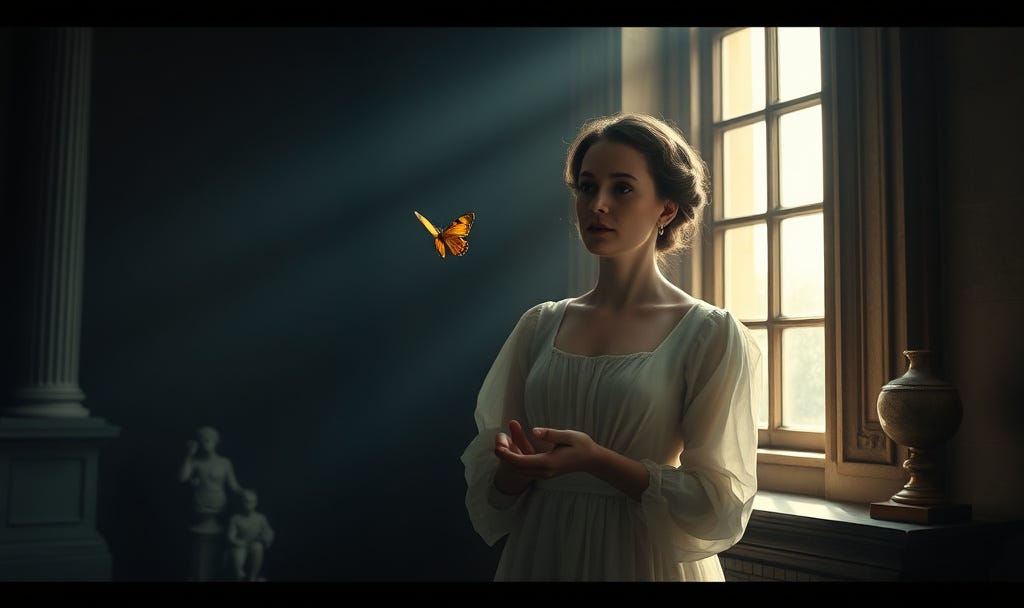
The world of science, war, and destruction is presented as masculine—Victor’s domain—perpetually at odds with nature. This is made visual in the wolves, in weapons, and in the cold laboratory space. In contrast, butterflies—symbols of beauty and innocence—are associated with Elizabeth and the feminine.
The creature comes to understand violence as inevitable in the world man has made. “Nature calms, knowledge unhinges.” The butterfly becomes a haunting symbol of transformation: a being that simply lives on, with “three hearts, multiple eyes, and white blood,” and, as Elizabeth observes, a “fascinating lack of choice.”
Choice, she says, is uniquely human—“the seat of the soul,” a gift of the creator. Elizabeth, who does not belong to the harsh masculine world, chooses life. Victor chooses its corruption.
One of the most critical changes the film makes is moral. The creature is less a perversion of life than a miraculous assemblage of the “discarded dead” of endless wars driven by human ambition. And yet, in spite of this origin, Elizabeth recognizes in him something she herself has long sought but could not name: love. She echoes the allusions drawn by Shelley to Milton. “To be lost and found: that is the lifespan of love,” she says, invoking the ideal.
The creature’s instinct is kindness, seen in his care for the cottagers and his bond with the blind old man. The novel leaves open the question of whether the creature is good or evil. The film makes a clearer choice: the creature is good, and he is wronged—abandoned and denied.
The head of Medusa looms over the creation process in Victor’s laboratory. The image reinforces the film’s central inversion: what is created is not inherently monstrous, but made so by the gaze that fears and rejects it. It is one of many visual symbols that compliments the technical achievements of the film at the 98th Academy Awards: production design, costume design, and makeup and hairstyling. These are not merely aesthetic or atmospheric, but acknowledgments of how deeply the visual language supports the story’s argument. From the recurring red of blood and life, to the stark contrast between the cold laboratory and the living world of nature, every detail is constructed to reflect a world out of balance—a world in which creation has been severed from responsibility.
The creature is made unhappy in isolation. His rage emerges as a response to rejection and the fearful attitude from others that pushes them to violence. He is also envious of the companionship that is denied him. Victor refuses to give him a mate, fearing the creation of a new race. And so the film raises, without resolving, its central question:
What gives man the right to play God—to decide who lives and who must remain alone?
The creature, like the butterfly—and like women in Shelley’s world—is denied choice. He must go on alone.
And yet there is a moment of transformation. After forgiving Victor, the creature saves the sailors. In that act, he becomes something more than what was made of him.
Shelley’s novel has often been read as a warning about scientific progress and its consequences—from industrialization to climate change. The film extends that warning into the present. If the creature represents what humanity creates, then the true question is not whether creation is monstrous.
It is whether the creator will act with responsibility.
Man has created artificial intelligence. The test now may be the same: whether we guide what we create ethically, or abandon it. That choice may determine whether our creations destroy us—or expand our understanding of what it means to be human.
Mary Shelley's Frankenstein

I can’t say it is one of my better essays. In the spring semester of 2015, I took History of Europe 4380 with Dr. Smith at Northwestern State Universit…