
Presence Versus Convenience
Once upon a bookstore, still a bookstore: a small ecosystem of books, coffee, and time


The indie bookstore of my Baton Rouge childhood was Elliot’s. It sat in a shopping center that is now a Walmart, just a few doors down from Coffee Call—not the Coffee Call of today, but the one I remember from the 80s and 90s, with its unmistakable art deco style and picturesque facade.
The current location of Coffee Call still carries an echo of that design, but from the outside—with a drive-thru running along the side—it feels like a shadow of what it once was.
That’s life. Nothing stays exactly the same.
Even the most committed “shop local” advocates know how hard it is to resist the gravity of Walmart and Target—prices, convenience, everything under one roof. Still, there was something particular about the old Sunday rhythm: church, then coffee at a locally owned café, then a slow walk through an independent bookstore just a few steps away, and finally a stop at the candy store in that same shopping center.
Local ownership. Local pride. A small ecosystem of books, coffee, and sweets.
Coffee Call survived. I’m pleased about that. It moved, changed, adapted—but it’s still here. Elliot’s is gone, edged out by the Barnes & Noble that opened on Corporate Boulevard. The candy store is gone too.
Years later, living in the Philly suburbs during my time in the Navy, I watched You’ve Got Mail. I’ve loved it ever since. Tom Hanks opens his big-box “Fox Books” around the corner from Meg Ryan’s The Shop Around the Corner. It felt familiar—Elliot’s and Barnes & Noble in different costumes, with Starbucks quietly threading through the background.
A delightful rom-com by Nora Ephron—and a modernization of a Jimmy Stewart classic.
But I never held it against Barnes & Noble.
They had books—so many books—and places to sit, to linger. That mattered. It still does. I’ve always loved reading spaces more or less indiscriminately. Indie, chain, mall store, hole-in-the-wall used emporium—it didn’t matter. If there were books, I was happy.
Then came the Nook.
I bought mine at the Barnes & Noble in Long Beach. I loved it immediately—the lightness, the portability, the idea of carrying an entire library in my hand. I filled it quickly.
And then, sometime around 2013, those ebooks were simply… gone.
The Nook ecosystem shifted. Access changed. Titles disappeared. Whatever the technical explanation, the experience was simple: I had paid for ebooks I could no longer access.
That felt like a breach.
I had already forgiven Barnes & Noble for being the “Fox Books” to Elliot’s. But this—this was different. So I moved to Kindle, like many people did. Convenience won again.
And yet.
There’s a recent piece in The Atlantic by Henry Grabar about the shifting perception of Barnes & Noble—how the old narrative of chain versus indie doesn’t quite hold anymore. The terrain has changed. The real divide now is something else entirely.
Ten years later, there is something different about the book business. Maybe it’s social media, Silicon Valley fatigue. Maybe it’s the weight of too much frictionless everything—the constant availability, the algorithmic sameness, the quiet sense that something human has been flattened in the process.
I still use Amazon. I publish through it. I can’t afford not to.
But I also find myself rooting—for places, for spaces, for something a little less efficient and a little more alive.
Barnes & Noble, of all places, seems to be finding its footing again. A chain, yes. A former disruptor, absolutely. But also—now—something closer to a steward of physical browsing, of discovery, of presence.
Third time’s a charm, maybe.
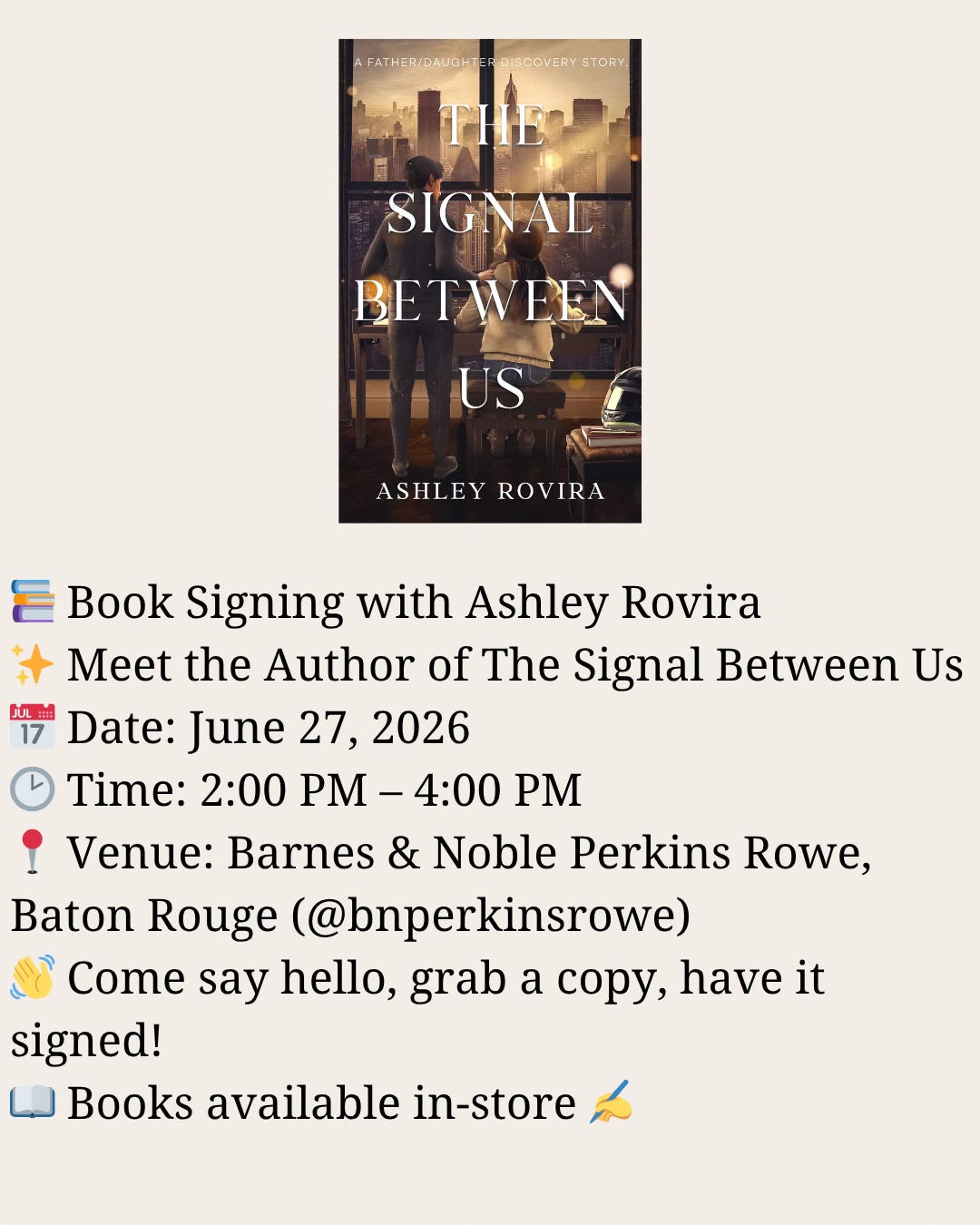
I emailed the manager at the Perkins Rowe location here in Baton Rouge, asking if they might be interested in carrying my book on consignment.
He said yes.
More than that—he offered me a signing. I didn’t even ask.
So on Saturday, June 27, I’ll be there from 2 to 4.
Not at Elliot’s. That place is gone.
But in a bookstore. A chain, yes—but as that Atlantic piece suggests, the old lines have blurred. It’s no longer simply indie versus corporate. It’s something more fundamental: presence versus frictionless convenience.
A place where you walk in, pick up a book, carry it in your hands. Where you stand in line. Where you wait your turn. Where a person rings you up at a register.
Books in hand. People employed. Time, acknowledged.
The transaction isn’t the point anymore. The encounter is.
It’s not that we don’t value indie stores. I do. My book is also on consignment at Cavalier House Books in Denham Springs—a place that holds exactly the kind of quiet, local magic I grew up with.
But this—this revision of an old economic argument—is part of the same ecosystem too, now. A different branch of it.
So on Saturday, June 27, I’ll be at the Barnes & Noble at Perkins Rowe—from two to four, standing behind a table, in the middle of that exchange. Not nostalgic for what’s gone, but participating in what remains.
If you’re not following already, use the embedded post below to access Heavy Crown Press on Instagram.

Update: I just logged back into my old Barnes & Noble account—my Nook books are still there.
Not gone after all.