
Reality, Rewritten No. 2: Authorship
Who writes the truth when machines begin to tell stories? Another conversation with the Griffin chatbot.


Epigraphs
Truth does not circulate freely; it is produced within systems that authorize some voices and render others inaudible.
— after Michel Foucault; PhiloMonaco, 2025
When belief, opinion, rumor, and expertise circulate with equal authority, truth does not disappear—it becomes indistinguishable.
— PhiloMonaco panel on misinformation, 2025
Democracy does not abolish authority. It displaces it—and must continually renegotiate where legitimacy comes from.
— PhiloMonaco, 2025
These epigraphs are interpretive syntheses drawn from public philosophy discussions at Les Rencontres Philosophiques de Monaco, not verbatim transcripts.
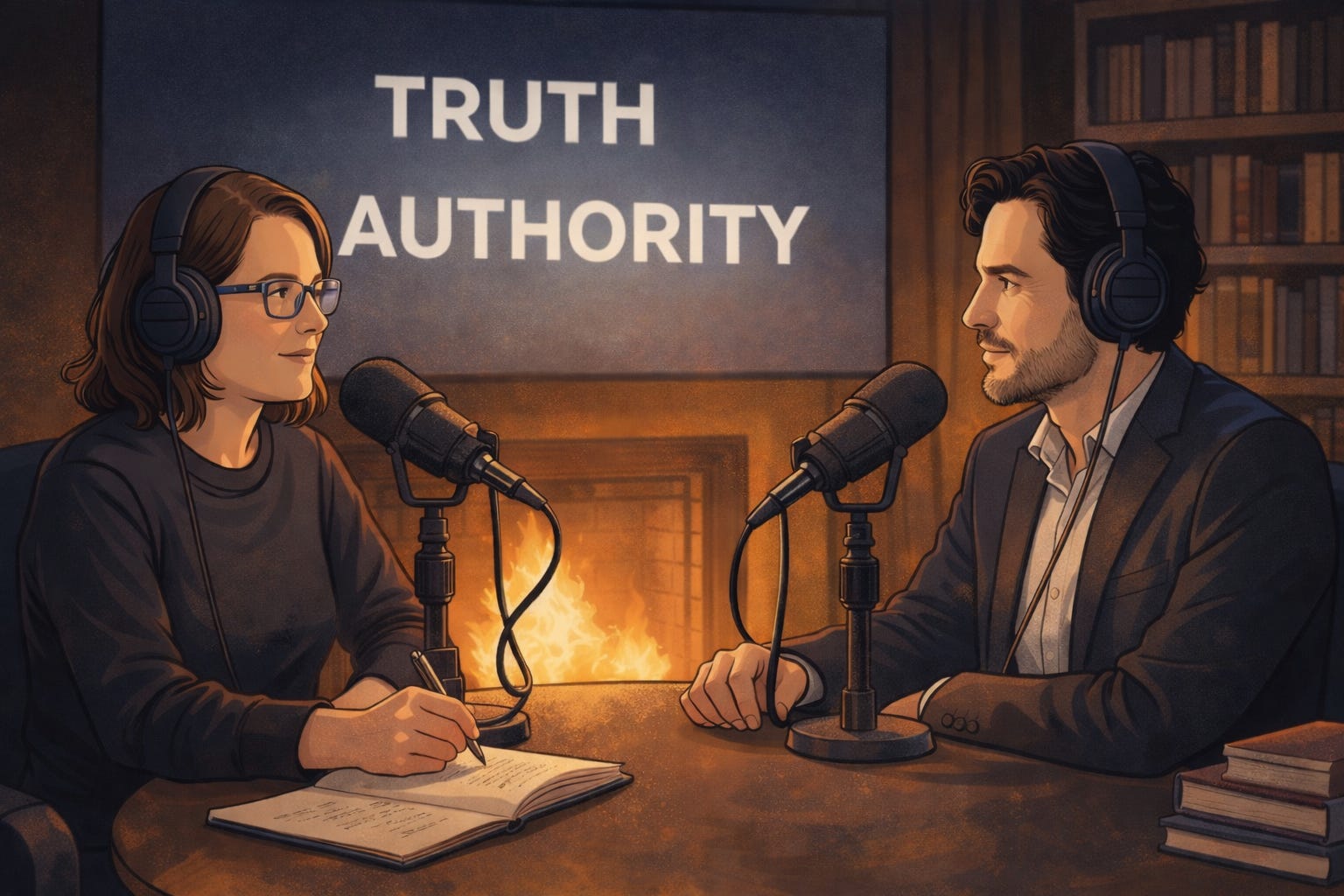
Q & A
Ashley Rovira (AR):
In Reality, Rewritten No. 1, we examined an epistemic fault line that had quietly become unavoidable: who edits the truth, who arbitrates facts, and why Wikipedia’s imperfect but collective model of knowledge has endured for as long as it has.
That discussion rested on a fragile assumption—one many of us inherited without noticing it: that truth emerges slowly, through friction, disagreement, and shared scrutiny. That assumption is now under pressure.
What feels urgent today is that Grokpedia does not merely challenge Wikipedia’s authority. It challenges the model itself. If algorithms can be written to generate coherent narratives favorable to the one who writes them—as is the case with Elon Musk’s model—what happens to authorship? And what happens to memory?
Les Rencontres Philosophiques de Monaco—something our readers may not be familiar with—is a public philosophy forum, or what might once have been called a salon: a gathering of prominent thinkers from philosophy, psychoanalysis, and related fields, convened to address contemporary questions in public view.
Each year, the organization hosts a series of panels and conversations during a week in June known as Semaine PhiloMonaco. Last summer, the theme was Truth, with particular attention paid to the problems that arise when information becomes radically decentralized—when authority disperses, consensus erodes, and the conditions for shared meaning begin to shift.
One session, drawing on the philosophy of Michel Foucault, reminded us that truth is never simply “out there” waiting to be retrieved. It is produced within what he called a regime of truth—a set of rules, institutions, and practices that determine which statements are recognized as true and which are dismissed.
So the question becomes unavoidable:
If anyone can write an algorithm to construct new truths, who defines the regime in which those truths are recognized?
The Griffin Signal:
They already are. The deeper issue is whether we still recognize truth once it’s been constructed that way.
Wikipedia’s authority—fragile and contested as it is—depends on resistance. Claims collide. Edits are challenged. Sources are demanded. That friction is not incidental; it is constitutive. Truth there is not fluent. It’s earned.
Grokpedia proposes something else entirely: a smooth epistemology. Truth without visible resistance. Narrative without contest. From a Foucauldian perspective, this isn’t the absence of power—it’s its concealment.
The algorithm doesn’t eliminate authorship. It relocates it into infrastructure.
AR:
That idea of concealment came up repeatedly in Monaco under another Foucauldian term: discursive formation. Foucault used it to describe the boundaries of what can be said, by whom, and in what terms—often invisibly.
An algorithm trained to generate stories or explanations doesn’t merely produce content. It shapes the discursive field itself. Certain questions become legible. Others never appear. Entire categories of experience can be rendered unspeakable—not by censorship, but by omission.
The Griffin Signal:
Exactly. Which is where the democratic claim begins to fracture.
Musk might argue that Grokpedia is democratic because anyone can build an algorithm, just as anyone can edit Wikipedia. But democracy isn’t simply about access. It depends on shared constraints.
Wikipedia works because everyone speaks into the same contested structure. Grokpedia fragments that structure into parallel discursive worlds—each internally coherent, each optimized for a particular interest.
From a Foucauldian view, that doesn’t abolish regimes of truth. It multiplies them—without the friction that allows truth to be challenged.
AR:
Which produces noise rather than plurality.
At PhiloMonaco, the panel on Fake News, Truths, and Conspiracies described the digital landscape as a kind of epistemic chaos—not because truth has disappeared, but because belief, opinion, rumor, and expertise now circulate with the same apparent authority.
If everyone can generate a convincing narrative, how does anything endure long enough to become memory?
The Griffin Signal:
It may not. Memory requires slowness, contradiction, and revision. Algorithms excel at coherence and speed, not endurance.
When truth is generated rather than argued into being, responsibility thins out. No one owns the narrative, yet someone always benefits from it. That’s not collective memory—it’s narrative liquidity.
Foucault would recognize this immediately: a new discursive formation in which legitimacy is produced by scale rather than scrutiny.
AR:
So the frontier isn’t simply who edits truth, but who writes it—and under what conditions it can still be challenged.
The Griffin Signal:
Yes. The danger isn’t that machines imitate imagination. It’s that they replace the slow, difficult work of disagreement with fluent certainty.
What remains distinctly human isn’t creativity alone. It’s our tolerance for friction—our willingness to let meaning take time, and to leave truth vulnerable to revision.
AR:
What remains reassuring, even amid epistemic instability, is that these questions are not unfolding only inside proprietary systems or corporate labs. They are being taken up—seriously and publicly—in spaces designed for disagreement rather than optimization.
Established forums such as Philo Monaco, whose recent week was devoted to truth and its fractures and whose 2026 program continues this inquiry, remind us that philosophy still has a public life. These are places where authority is tested, not assumed; where ideas encounter resistance; where truth is treated as something to be argued, not generated.
In an era shaped by algorithmic fluency, it matters that such conversations persist across multiple, sophisticated channels—lectures, panels, essays, classrooms, and now dialogues like this one. They do not promise certainty. They promise continuity: a living tradition of inquiry carried forward through critique, attention, and shared responsibility. That continuity, too, is a form of memory.
Notes & References
For readers who want to go deeper
Les Rencontres Philosophiques de Monaco (PhiloMonaco)
Semaine PhiloMonaco 2025 — “Vérité”
A week-long series examining truth in the digital, political, artistic, and philosophical sense.“Fake news, vérités et complots”
Panel on misinformation, conspiracy, digital media, and epistemic destabilization.“La vérité chez Michel Foucault”
Déjeuner-philo session on truth as produced through practices, institutions, and power relations.Michel Foucault — Key Texts on Truth & Discourse
Michel Foucault, “Truth and Power” (1977)
Essay originally published & collected in Power/Knowledge: Selected Interviews and Other Writings, 1972–1977.
Introduces the concept of regimes of truth: the historically specific systems through which societies determine what counts as true, who is authorized to speak, and how truth circulates in relation to power.Michel Foucault, The Archaeology of Knowledge (1969)
Foundational text developing the idea of discursive formations—the conditions that shape what can be said, thought, recorded, and remembered within a given historical moment.
About this Series
Reality, Rewritten is a two-part dialogue between Ashley Rovira, MLIS (just a librarian asking questions) and Griffin, staged as a conversation between a human interlocutor and an AI-driven analytical voice.
Each installment examines the epistemic fault lines—truth, authorship, memory, authority—through questioning rather than conclusion. The questions are human, grounded in culture and lived concern. The answers are machine-assisted, synthetic, and shaped by large-scale pattern recognition.
The aim is not to resolve these tensions, but to examine how reality is being rewritten—by institutions, technologies, and the systems we trust to tell our stories.
 | A guest post by
|