
Wake Up Dead Man (where the devil awaits)
On power, faith, and the making of a scapegoat

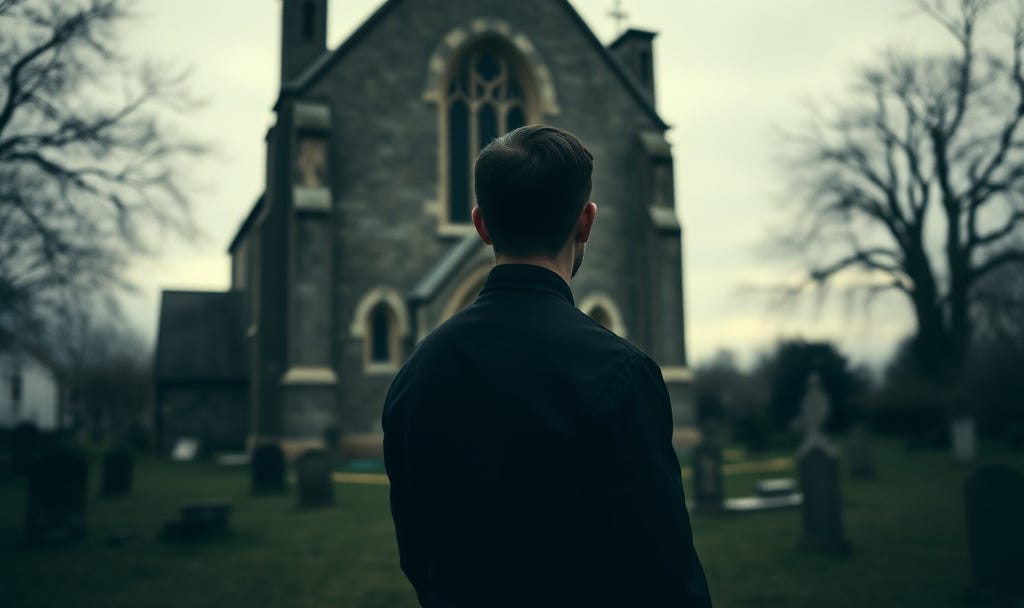
Wake Up Dead Man, the third and latest Knives Out mystery on Netflix, is a hoot—though a darker one than its predecessors. Wake Up Dead Man: A Knives Out Mystery finds Daniel Craig returning as private eye Benoit Blanc, this time stepping into a quaint village where Old World and New World sensibilities collide in unsettling ways.
Rian Johnson assembles another impeccable ensemble: Josh O’Connor, Andrew Scott, Glenn Close, Josh Brolin, Mila Kunis, Jeremy Renner, Kerry Washington, Cailee Spaeny, and Daryl McCormack—a transatlantic mix that quietly reinforces the film’s central idea: hypocrisy travels well.
At the center are two priests, played by Brolin and O’Connor. O’Connor, who previously wore the collar as Mr. Elton in the 2020 adaptation of Emma, returns here as a Catholic priest marked by a violent past—reformed, perhaps, but unmistakably burdened. There is nothing more suspicious than a man who insists he has changed.
And yet it isn’t O’Connor who unsettles most—it’s Brolin. His Wicks exudes a controlled menace, the kind that doesn’t need to announce itself. Opposite him, Close (playing Martha) is formidable, operating at the other extreme: composed, knowing, and quietly terrifying. As O’Connor’s character observes, Wicks may be in charge, but Martha is the one who knows where the bodies are buried.
The structure is pure Agatha Christie: a closed circle of suspects, a carefully constructed social microcosm. The village and church feel like they could belong to a Miss Marple story—if Miss Marple wandered into something far more morally volatile.
Because this is where the film sharpens.
Patriarchy has no borders. Hypocrisy is universal. Emotional manipulation transcends culture, language, and even belief. Religion, in Johnson’s hands, becomes less a doctrine than a stage on which power performs itself.
There’s a father–son reveal that leans knowingly into myth—its echo of Star Wars (“we will rule together”) both unsettling and absurd. It’s one of several moments where the film invites you to laugh—and then immediately questions why you did.
That tonal balance is the film’s real achievement.
It is dark, often uncomfortably so. But it is also funny—sharply, deliberately funny. And that humor doesn’t dilute the weight of its subject. If anything, it exposes it. Religion, after all, carries contradictions that resist resolution and leaves behind wounds that don’t easily close. To find humor within that space without trivializing it is no small feat.
Here, the humor works because it feels true.
The absurdity isn’t imposed. It’s revealed.
The laughter cuts through.
Not as relief, exactly—but as release. A loosening of tension just enough to let something else in. The mind opens a fraction, and in that opening, a pattern begins to take shape.
It is not new.
A man formed within a system that protects him, elevates him, names him shepherd—only for him to grow quietly resentful of the very flock that sustains his authority. Their devotion becomes a mirror he cannot bear to look into for too long. Their freedom, however small, becomes intolerable.
Control, then, becomes the answer. Not loudly. Not all at once. But gradually, almost imperceptibly, until it feels like doctrine.
He cannot turn his anger upward—toward the structure that made him—so he redirects it. Sideways. Downward. Toward the one who can be named, isolated, and offered up.
A scapegoat.
A woman, often. The harlot. The witch. The one whose existence can be reframed as disorder. In another story, she might wear a pointed hat and green skin. In this one, she carries the weight of knowledge—of what has been done, and by whom.


What the film understands—quietly, almost too well—is that patriarchy does not depend on geography. It travels. It adapts. It survives translation.
The laughter passes. The story resolves.
But something quieter settles in its place—the recognition of a pattern that does not end when the film does.