

Everyone is saying it now. Or if not saying it, then feeling it—somewhere beneath the surface, like pressure before a storm. The sense that something is off. That the world has become harder to read, harder to trust, harder to name.
It shows up in small ways. A hesitation before accepting a fact. A quiet suspicion of expertise. A sense that institutions—once slow, stable, and authoritative—are now either fractured or performing stability rather than embodying it. We move through a landscape saturated with information to the point of vertigo.
It is tempting to try to locate a beginning—to point to moments when there was a turn: an election, a referendum, a crisis. Trump. Brexit. The Tea Party. 9/11. Each offers itself as an origin story, a clean break between before and after.
But the feeling resists that kind of precision. It suggests something older, more gradual. Not a rupture, but an accumulation. A long erosion of shared frameworks for understanding what is real, what is true, what can be trusted.
Go back far enough and the pattern begins to repeat. The language changes, the stakes shift, but the underlying structure remains: competing narratives, institutional strain, a growing distance between lived experience and official explanation. The present does not feel unprecedented—only intensified.
We live inside it.
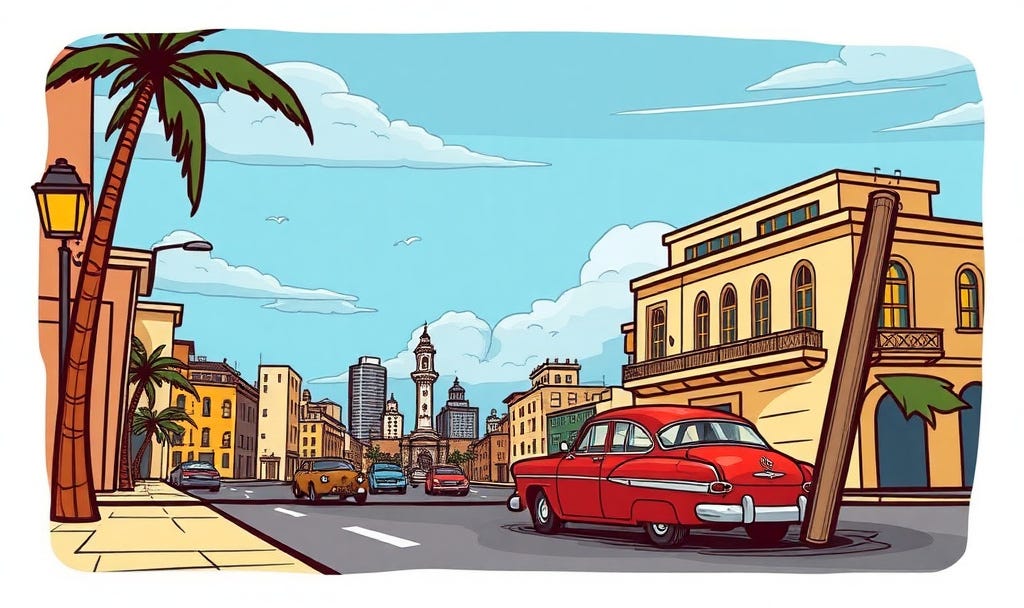
Our Man in Havana, by Graham Greene
Graham Greene didn’t write ordinary noir—whatever that would be. He was totally different from Chandler and Hammett. His spy “entertainments,” as he called them, were less about systems than individuals. Individuals caught up in those systems. People pulled into espionage while trying to do other things.
In Our Man in Havana, the central tension is not simply between truth and lies, or crime and evidence, but between systems and persons.
Religion, nation, ideology—these are systems. They rely on repetition, belief, and loyalty at scale. They offer structure, but they also demand submission.
Against them stands something smaller and far less stable: the individual life lived for a person rather than an idea.
Wormold doesn’t belongs to systems. He is detached from Milly’s Catholicism, unmoved by patriotism, and only loosely attached to capitalism, where even selling vacuum cleaners becomes nearly impossible in a world shaped by Cold War fear—where “atomic” power repels more than it attracts.
He fails within every system he encounters.
So he invents one.
In the absence of success, he fabricates it—agents, networks, intelligence. And yet his fiction somehow folds into reality. It enters the machinery of espionage and operates outside of his control, endangering lives.
Beatrice recognizes the absurdity of the game because she has lived inside it. But she also sees something else in Wormold: a way of moving outside the system, improvising rather than obeying.
Milly, too, appears to belong to a system—Catholic, structured, moral—but her instincts mirror her father’s. She plays the game, but does not fully inhabit it. Beatrice sees this, and comes to love them both.
It is a dangerous love only because it collides with a world organized around systems—espionage, ideology, Cold War logic.
Greene leaves us with a quiet, impossible proposition: that if loyalty to persons replaced loyalty to systems, the world might be less efficient, less coherent—but far less violent.
